Make the next check visible
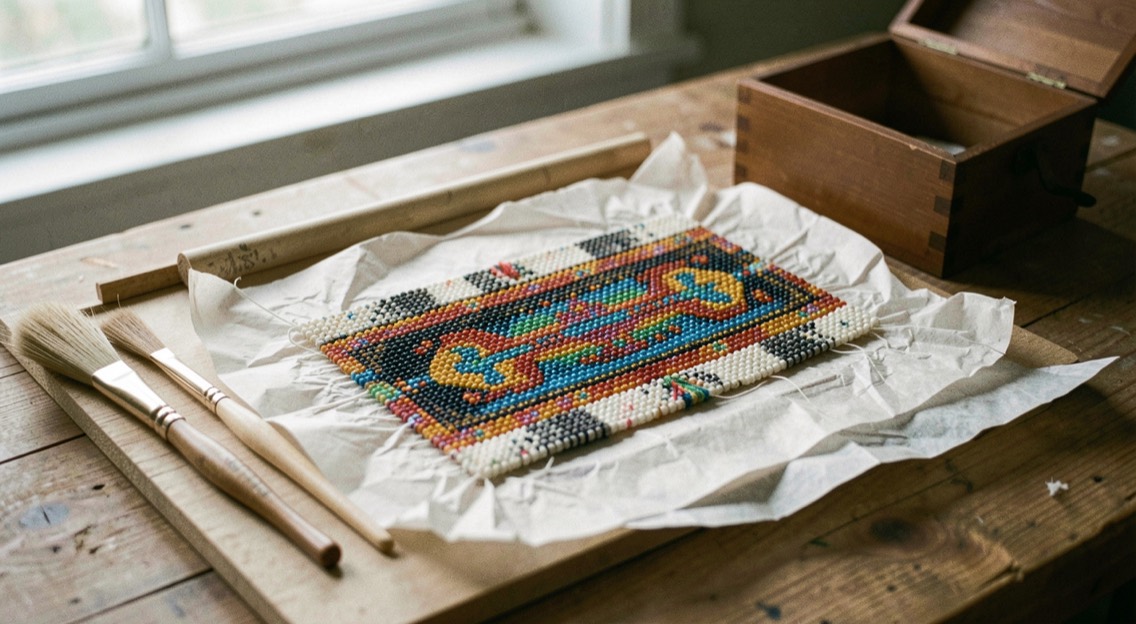
The Canadian Conservation Institute recommends checking for loose beads before moving a flexible object and placing support beneath it. Its guidance also emphasizes dark storage, dust control, support for fringes, and caution around unstable glass. These principles are conservative because thread or backing can fail while beads still look intact.
For an everyday piece, begin with gentle handling and a clean, dry storage environment. Avoid immersion and aggressive cleaning. If there are cracked beads, a crusty deposit, loose support, or high value, stop and ask an experienced conservator.
Bench checklist
Before you commit
- Name the exact family or operation behind how to store beadwork.
- Keep the source and retrieval date beside any precise claim.
- Identify the dimension, finish, or junction that limits the project.
- Test the intended materials before committing to the full design.
Keep the caveat
What this page leaves visible
A familiar label can organize a question, but it cannot prove that two materials are interchangeable. Keep the publisher's caveat attached and leave unknowns visible.
Evidence pack
Sources close to the decision
- Canadian Conservation Institute, Government of Canada: Care of Objects Decorated with Glass BeadsSupport, storage, light, dust, moisture, cleaning limits, and conservator referrals for fragile beaded objects.Museum conservation guidance is deliberately conservative and should be adapted carefully to an everyday piece. Checked August 24, 2026.
- MIYUKI Co., Ltd.: Delica Color and DurabilityThe A, B, C, D, and N caution meanings used in the finish guide.MIYUKI says the examination and manufacturing-history data are not absolute and can differ with use and environment. Checked August 24, 2026.